 en
en es
es nl
nlInformation About Theresia Maria (Trees) van den Beemt
Basic information
Name: Theresia Maria (Trees) van den Beemt
Born: January 15, 1925 in Halsteren
Died: June 6, 2011 in Bergen op Zoom
Father (parent 1): Johannes Andreas (Jan) van den Beemt (m)
Mother (parent 2): Dominica Maria Elisabeth (Mien) Kramer (f)
Marriage / Relationship
Married: July 28, 1947 in Bergen op Zoom with Marinus Marie (Rinus) Withagen (m) .
Children
- H. Withagen (f) .
- M. Withagen (f) .
- F. Withagen (m) .
- J. Withagen (m) .
- M. Withagen (f) .
- R. Withagen (m) .
- J. Withagen (m) .
- E. Withagen (f) .
- L. Withagen (f) .
- K. Withagen (f) .
- M. Withagen (m) .
- J. Withagen (f) .
Sources
- wie-was-wie 112965426 (Marriage Marinus Marie Withagen and Theresia Maria van den Beemt)
Memories
Memories are based on documents, family lore or personal experiences. They give more information about a person, but are not necessarilly complete or correct.
For photos: click on the photo for a larger format; email family@grivel.net for more information about the photo.
Photo of the twelve children of Johannes Andreas van den Beemt and Dominica Elisabeth Maria Kramer, ca. 1938?
In the back: Hedda, Jan, Nicky, Leo, Gré, Stof. In front: Harry, Trees, Maria, Frans, Cees, Ben

—Eric Grivel
It was in Halsteren, at the Halsterseweg number 79, in House Delta, that I was born. Dad and mom van den Beemt moved there from Dordrecht in 1922. Harry was born there in 1923 and I was in 1925.
—Trees van den Beemt
recorded in “Treesje van de Zoom”
by Elselien Withagen, 2005
There was a strict dress code back then. As a woman you could not go to church without a hat, while men had to take off their hats. At school the girls’ skirts were checked to make sure they were long enough. You had to sit on your knees for that. If the skirt didn’t touch the floor, you were sent home to get properly dressed. If you had short sleeves in the summer, you had to put your elbow on the table. A sleeve that did not touch the table was rejected and you were sent back home for that too. The nuns were, I believe, really pious, but the pastor was not all that proper. He found the breast pocket that I had on my blouse so interesting that, while he put his hand in it, he said, “What a nice pocket you have there.”
—Trees van den Beemt
recorded in “Treesje van de Zoom”
by Elselien Withagen, 2005
My favorite activity was reading. We were a member of the library and there I read all the books by Jules Vernes, Pietje Bell, Dik Trom and Old Shatterhand and Winitou.
—Trees van den Beemt
recorded in “Treesje van de Zoom”
by Elselien Withagen, 2005
Trees was always reading. And when she had finished all the books in the Catholic library, she secretly went to those of the Protestants. She made sure Father didn’t know, because he would have been furious...
—Maria van den Beemt
recorded in “Treesje van de Zoom”
by Elselien Withagen, 2005
After primary school Netje de Vries came to help as a servant [at my father’s house]. It used to be common to start working after primary school, after all, you had to eat. This was also true for the De Vries family. Netje worked full days. In the morning she went with Dad after the 7 o’clock mass to the Zoom where she started work after breakfast. She was often teased by my brothers: putting knots in her hair, putting her in the blanket box. Netje could laugh about it. She felt really at home. About 7 hours a day, for 50 cents a week (that's 23 modern euro cents) plus board. When it was cold, she came inside to iron or mend stockings. Netje and I also went sliding with the little ones (Frans, Maria, Kees) and throwing snowballs. That was fun.
When Rinus and I moved from de Zoom to Vlierstraat, Netje continued to help us. We knew each other well. After so many years of working together you know each other through and through. We also had fixed habits. For example, we always worked the house from the bottom up, so it was nice and tidy downstairs. In the end, Netje retired at the age of 78. She had worked for us for 65 years and had her farewell party in Lekstraat. After 65 years that is only fair, right?
—Trees van den Beemt
recorded in “Treesje van de Zoom”
by Elselien Withagen, 2005
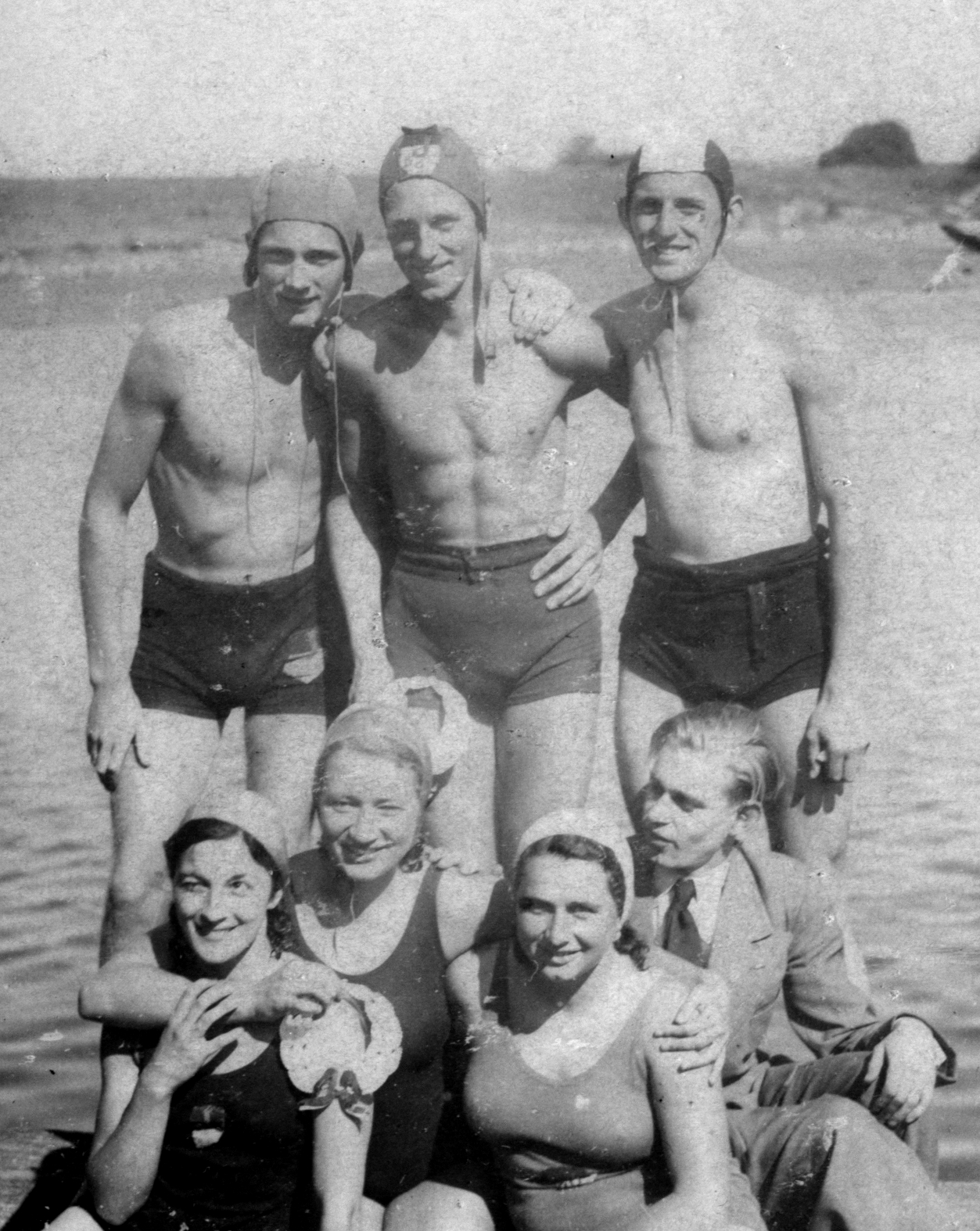
Although Dad did not allow it, I secretly went to dance class. That was at Becht in the Kerkstraat because you could get private lessons there for little money. All my quarters went there in those days. [...]What Dad allowed me to do was swim. In the morning at six o’clock I ran with Leo to Zanderijen to do our lanes and we had to make sure that we were back in the church at 7 o’clock.
July 1945. The numbers 1, 2 and 3 of the 1200 meter competition at the Havendijk. In the back: Hans de Haal, Wil Verbeek, Rinus Verpalen. In the front: Joke Verpalen, Ria Klupper, Trees van den Beemt and trainer Ad Vriens.
We had a subscription for the old swimming pool for 12 guilders for the whole family for the entire swimming season: from May to October.
Every year there was the 1200 meter race at Havendijk. That was at the head of ’t Hoofd. I finished with the first three and the picture that is shown here was taken. My father had to cut off the bottom part of the photo with my bosom, because he thought that was way too immoral. Because that competition was well known, an enlargement of the photo was displayed in a shop window somewhere in the city. However, nothing was cut off from that photo and Pa thought it was terribly indecent (he was secretly very proud that his Treesje had finished among the first three).
—Trees van den Beemt
recorded in “Treesje van de Zoom”
by Elselien Withagen, 2005
At the back of our garden we dug an air-raid shelter, all the way around. Wood on the inside and a kind of spiral staircase (made of sand) so that we were protected from shards and bullets.
There was a large shelter with benches on the Stulemeijerlaan field. With an air raid alarm we had to go in, that was especially nice when we were on our way to church, because then the church service would not be held. Such an air raid alarm could last from half an hour to 45 minutes.
In the evening we were not allowed to go outside and all windows had to be covered with planks. (The Krauts did not allow the cities to be seen from the air because otherwise the Americans and British knew at night where the cities were located.) We had to hand in the radios, but also copper and silver coins went to the Krauts. They also removed the Carillon from the Peperbus tower. All that metal went to Germany to the arms factory. All food, sweets, carrots and milk were rationed. Coals, bicycle tires, clothing, and citrus fruit were also no longer available.
Twice a week I rode 15 kilometers and 15 kilometers back to Oud Vossemeer on a bike, with pieces of garden hose for tires. There we knew a place where we could buy two brown breads without coupons somehow. When I was shopping at the Halsterseweg, I had to pretend that I was injured and to bandage my hand, otherwise I would have to come and peel potatoes for our occupiers. I was also often asked for my identity card because I looked so Jewish (my nose, I guess). Fortunately the Krauts always trusted my papers. We also did not know at that time what really happened to the Jews when they were arrested, we had never heard of gas chambers and concentration camps while the war was going on. If I had known what was really going on, I would certainly have been a whole lot more nervous when asked about my “Ausweiss.”
—Trees van den Beemt
recorded in “Treesje van de Zoom”
by Elselien Withagen, 2005
House at the Noordzijde Zoom directly after the liberation of Bergen op Zoom: the house was heavily damaged, but a Dutch flag was flying.
After the liberation we could not stay in our house any longer, there were 14 direct hits. In the photo you can clearly see that our house was totally uninhabitable.
During the liberation, the guns were fired from the Heimolen by the Canadians to shoot the barricades of the Krauts that were on the other side of the Zoom. As you can see, they caused a lot of damage. The cigars that Pa had made specially by hand had also disappeared. They were meant for when Father would be buried. They were twelve large cigars, about twenty centimeters long, one for each of the sons and sons-in-law.
But we were happy that we were liberated and the flag went out! Of course we couldn’t live in our old house. Grandpa went to live with Leo and Nel and I with Nici and Frans. Maria and Frans went to live with the Dercks again, I think, and Kees went with Gré. It took at least six months before our house was rebuilt.

—Trees van den Beemt
recorded in “Treesje van de Zoom”
by Elselien Withagen, 2005
[I actually met Trees] by swimming club “Juliana.” My sister Riet was a member of that club and Trees collected the members’ monthly contribution.
One day, I think in the spring of 1946, we met on the sidewalk of the old Post Office in Zuivelstraat.
Trees asked: ”Isn’t your sister a member of the ‘Juliana’?”
“Yes, I think so,” I answered.
“But your mother doesn’t want to pay the contribution.”
“I’ll talk about it at home and you’ll hear from me about that; when can I see you?”
“Tomorrow, at restaurant De Schelde. At half past twelve I go to the town. My father is there at the polling station and I bring him his sandwiches.’
“Okay, see you tomorrow!”
Well, that became a long conversation. I don’t know exactly what, but Father van den Beemt had to wait a long time for his sandwiches.
And so... it happened!
—Rinus Withagen
recorded in “Treesje van de Zoom”
by Elselien Withagen, 2005
= privacy | = photo | = memories | = contact information | = age information.