 en
en es
es nl
nlInformation About Johannes Andreas (Jan) van den Beemt

Basic information
Name: Johannes Andreas (Jan) van den Beemt
Born: December 16, 1883 in Dordrecht
Died: May 31, 1968 in Wouw
Father (parent 1): Johannes van den Beemt (m)
Mother (parent 2): Margaretha Jacoba Buijs (f)
Marriage / Relationship
Married: November 25, 1909 in Dordrecht with Dominica Maria Elisabeth (Mien) Kramer (f) .
Children
- Margaretha Jacoba Dominica (Gré) van den Beemt (f) , born October 10, 1910 in Dordrecht, died December 21, 1982 in Bergen op Zoom .
- Leonardus Antonius Johannes (Leo) van den Beemt (m) , born November 17, 1911 in Dordrecht, died March 5, 1968 in Bergen op Zoom .
- Johannes Andreas Carl (Jan) van den Beemt (m) , born September 1, 1913 in Dordrecht, died October 7, 1990 in Tilburg .
- Christoffel Dominicus (Stof) van den Beemt (m) , born July 5, 1915 in Dordrecht, died December 21, 1988 in Gorinchem .
- (stillborn) van den Beemt (?), born July 5, 1915 in Dordrecht, died July 5, 1915 in Dordrecht .
- Dominica Maria Elisabeth (Nicky) van den Beemt (f) , born July 31, 1917 in Dordrecht, died May 16, 1993 in Roosendaal .
- Hedda Louis van den Beemt (m) , born June 15, 1919 in Dordrecht, died July 26, 1991 in Hoogvliet .
- Bernardus (Ben) van den Beemt (m) , born March 26, 1921 in Dordrecht, died May 22, 1994 in Hoogeveen .
- Hendrik Cornelis (Harry) van den Beemt (m) , born March 23, 1923 in Halsteren, died March 5, 2015 in Bergen op Zoom .
- Theresia Maria (Trees) van den Beemt (f) , born January 15, 1925 in Halsteren, died June 6, 2011 in Bergen op Zoom .
- N.N. van den Beemt (f), born September 20, 1926 in Bergen op Zoom, died September 20, 1926 in Bergen op Zoom .
- Cornelis Franciscus (Cees) van den Beemt (m) , born November 15, 1927 in Bergen op Zoom, died March 30, 1984 in Heerlen .
- Maria Margaretha Johanna van den Beemt (f) , born May 20, 1930 in Bergen op Zoom, died November 16, 2011 in Bergen op Zoom .
- F. van den Beemt (m) .
Profession: cigar manufacturer (1932).
Sources
- wie-was-wie 91909342 (Birth Johannes Andreas van den Beemt)
- wie-was-wie 23877476 (Marriage Johannes Andreas van den Beemt and Dominica Maria Elisabeth Kramer)
- wie-was-wie 92083038 (Death Levenloos van den Beemt)
- wie-was-wie 20044814 (Death N.N. van den Beemt)
- wie-was-wie 93149257 (Death Johannes Andreas van den Beemt)
- wie-was-wie 97212798 (Death Johannes Andreas van den Beemt)
Memories
Memories are based on documents, family lore or personal experiences. They give more information about a person, but are not necessarilly complete or correct.
For photos: click on the photo for a larger format; email family@grivel.net for more information about the photo.
He visited us regularly, I remember him reading to us or telling us stories. He always had a pipe in in mouth and a little box with licorice candy, of which I always got one. He used to sing this song for me, which also can be found at geheugenvannederland.nl (in Dutch):
Opa laat je neus eens zien
Opa die ging wandelen met zijn kleinzoon
Eens wandelen voor pleizier.
In een theetuin zo prachtig schoon
Dronk daar een potje bier.
De kleine was zoo in zijn schik
Hij had plezier voor drie,
En wipte in een oogenblik
Op opapa zijn knie.
Hoe vindt gij opapa, mijn zoon?
De kleine antwoord leuk:Refrein:
Opa, opa, wat heb je een lange neus,
Opa laat je neus eens zien,
Het lijkent wel een naaimachien,
Opa, opa, wat heb je een groote neus.Opa ging naar een bal masque,
Heel netjes aangedaan,
Nam paraplu en rotting mee,
Zijn pruik op, wel verstaan.
Hij vraagt een dame heel beleefd
En walst met haar in ’t rond,
Hij trapt haar vreeselijk op de teen
En struikelen op den grond.
Zijn pruik valt af, zijn hoofd is kaal
En alles schreeuwde door de zaal:Refrein
Opa ging naar een bruiloft heen
Waar hij eens zingen zou
Een lied, door huwelijksleven heen
Of liefde en berouw.
Sprong op een stoel en zong weldra,
Maar kreeg zoo’n raar gevoel,
Want door zijn heel zwaarlijfheid
Zakte hij door de stoel.
De dames lachten allen luid,
En zongen toen meteen,Refrein
Opa ging naar een meisje heen
Om nog te trouwen gaan.
Hij nam zijn portefeuille mee,
Met geld zeer zwaar belaan.
Hij vraagt het meisje heel gedwee
Of zij hem liefde biedt,
Ik breng een rijke bruidschat mee
Zooals dat gij hier ziet,
Het meisje heeft hem ras herkend
En lachend roept zij uit;Refrein
Als gij opa soms tegen komt,
Groet hem dan heer cerieus,
U kunt hem kennen overal,
Je kijkt maar naar zijn neus.
Zijn neus dat lijkt wel een leverworst
Zijn hoofd als een citroen,
Zijn mondje als een kolenbak,
Zijn ogen die zijn groen.
Het zingen dat is onze leus,
En zingen wij van opa’s neus.Refrein
Gebr. Bäcker van Bergen op Zoom.
—Dook Brörmann
What I remember from grandfather was that he was a friendly man. Modest, without any form of an attitude. He was very sweet to small children and as a child you felt at home with him, but it was also clear that he expected the children to listen to him.
I have heard that before the war he had organized a large transport with three railroad cars full of cigars and coffee to Switzerland. He invested most of his money in that transport. The transport was stopped on the border with Austria, and the train was robbed. That is why the factory in Dordrecht went bankrupt. Later he started another cigar factory in Bergen op Zoom.
The building in which he had the cigar factory in Dordrecht is still there; it later became the Dordrecht police station.
My grandfather and grandmother de Lie also lived in Bergen op Zoom. After my parents got married, my father’s brothers and sisters (and grandfather van den Beemt) also visit Grandpa and Grandma de Lie. The children sometimes got some extra food there.
—Wieke van den Beemt
December 2019
[The following are notes of a conversation I (Eric Grivel) had with my mother in March 2010.]
Why did Jan move to Bergen op Zoom?
There was an empty cigar factory in Bergen op Zoom. Grandpa was asked to take over that factory, because there was so much unemployment in the south. He did this together with a friend, Stumpel, who came along from Dordrecht as bookkeeper. There is a daughter of this Stumpel living in the service flat where I now live. This bookkeeper died before grandma died (so that must have been around 1934).
He first lived in Halsteren before moving to the Noordzijde Zoom 12. He had to sell the house in Halsteren, and Noordzijde Zoom 12 was rented until the Noorzijde Zoom 15 house was ready, where we moved next.
How did the cigar factory end?
Grandpa said it “was a good thing mother hadn’t seen it,” so the factory must have been disbanded in 1934-35. I once checked with the Chamber of Commerce, and there was no bankruptcy: the company was disbanded in an orderly way.
The factory was sold “to the nuns” because the export to Germany collapsed almost completely in the early 1930s, and Germany was a major market. Instead of waiting until it was too late, grandfather disbanded the company, paid all creditors, and let the personnel go with a couple of months of salary. But the lawyer who was handling the liquidation (mr. Peree) embezzled the money that was left (“filled one hole with another”) and went to prison for that. It is characteristic for grandpa that, when the lawyer had finished his prison term, he felt the issue was dealt with and they had a weekly bridge game. I also remember that we had to take the newspaper, when grandpa had read it, and deliver it to mr. Peree.
—Maria van den Beemt
March 2010
Photo of Johannes Andreas with five of his siblings, ca. 1890?
Photo courtesy Kramer familly
In this photo, from left to right:
- K. van den Beemt
- P. van den Beemt
- A. van den Beemt
- H. van den Beemt
- J. van den Beemt
- G. van den Beemt

—Eric Grivel
Photo of the twelve children of Johannes Andreas van den Beemt and Dominica Elisabeth Maria Kramer, ca. 1938?
In the back: Hedda, Jan, Nicky, Leo, Gré, Stof. In front: Harry, Trees, Maria, Frans, Cees, Ben

—Eric Grivel
Slideshow
“Snitzelbord” for the wedding of daughter Maria, with drawings (caricatures) of all the twelve children. Most of these drawings were probably re-used from his 75th birthday in 1958.
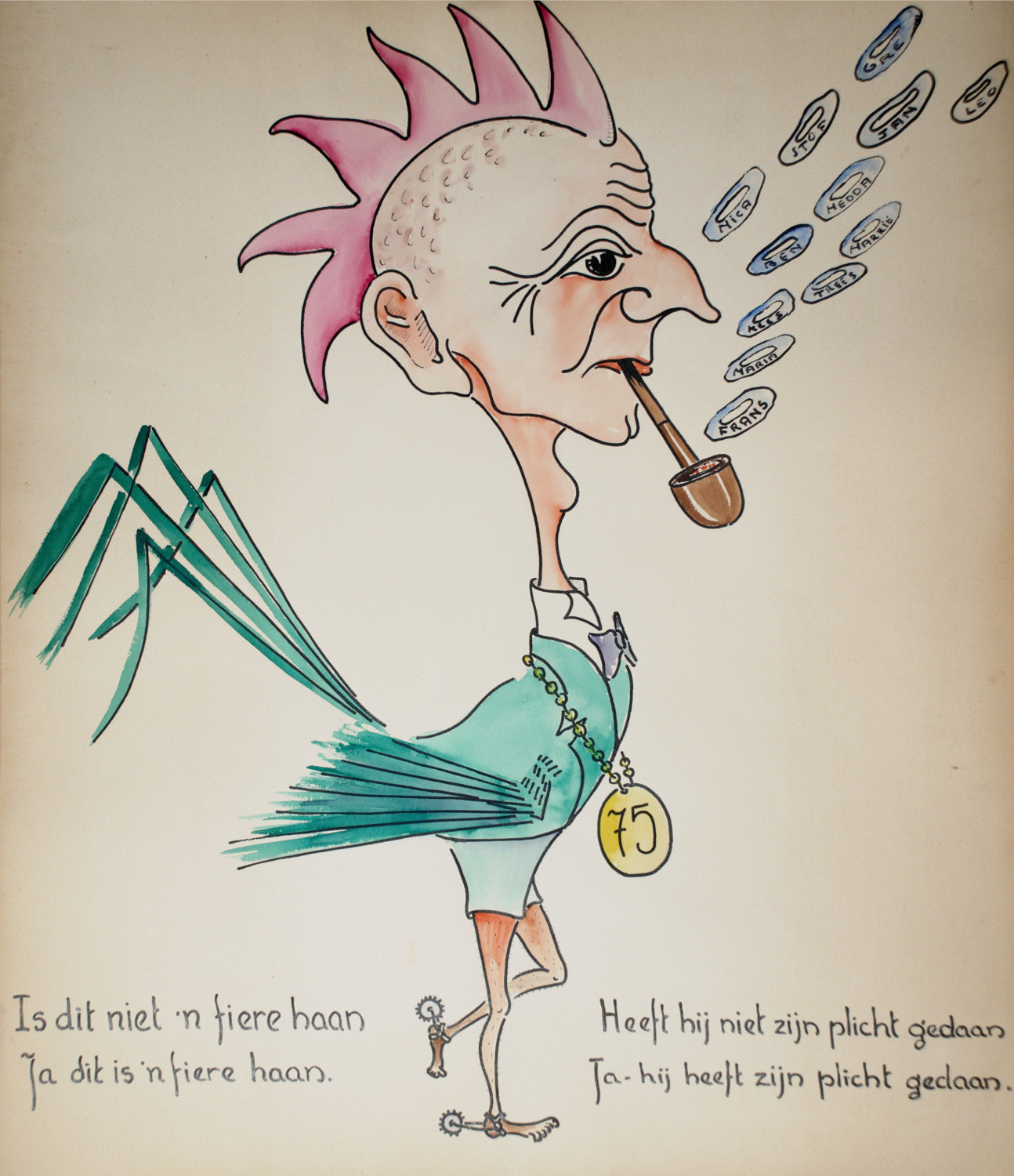
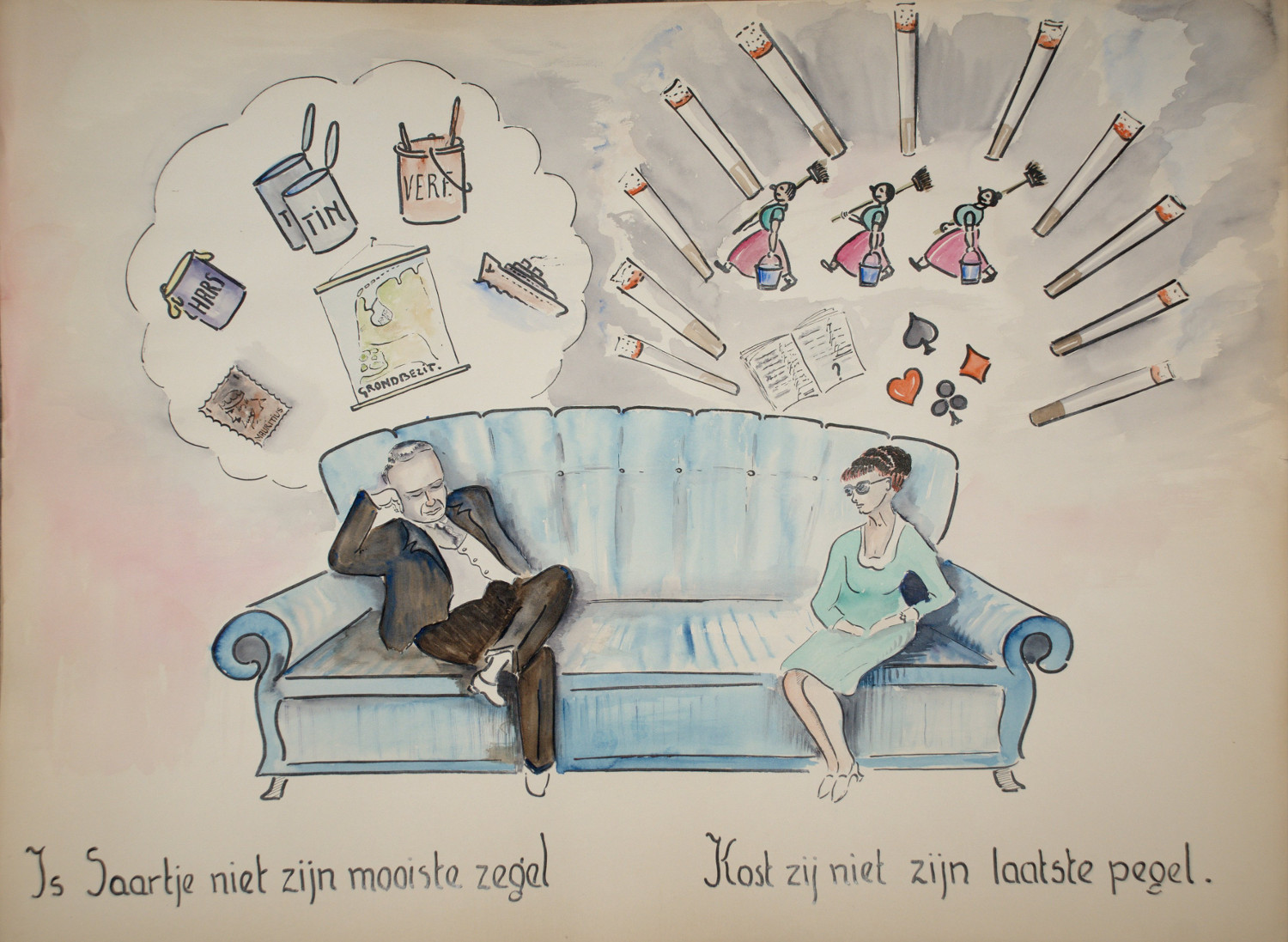
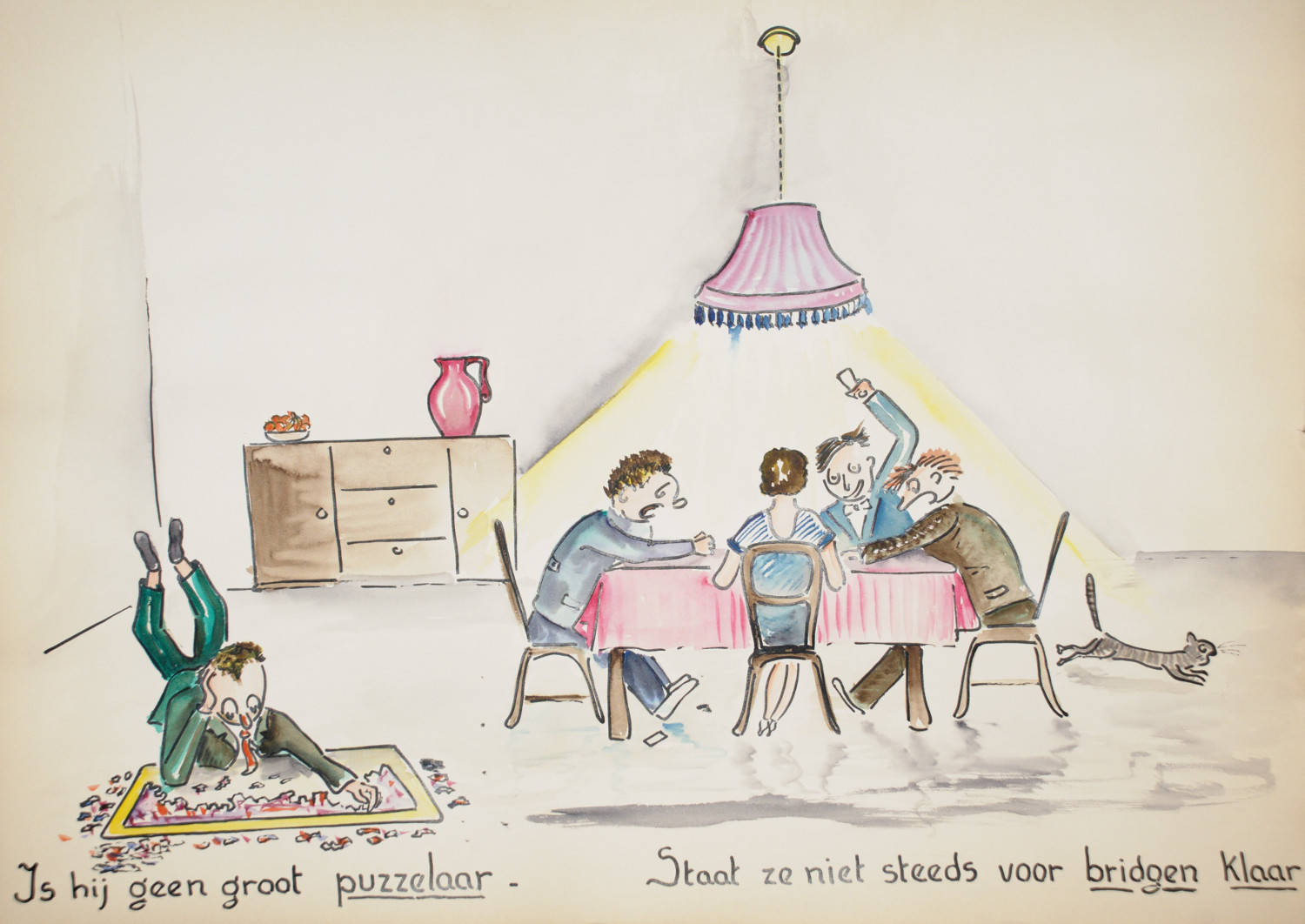
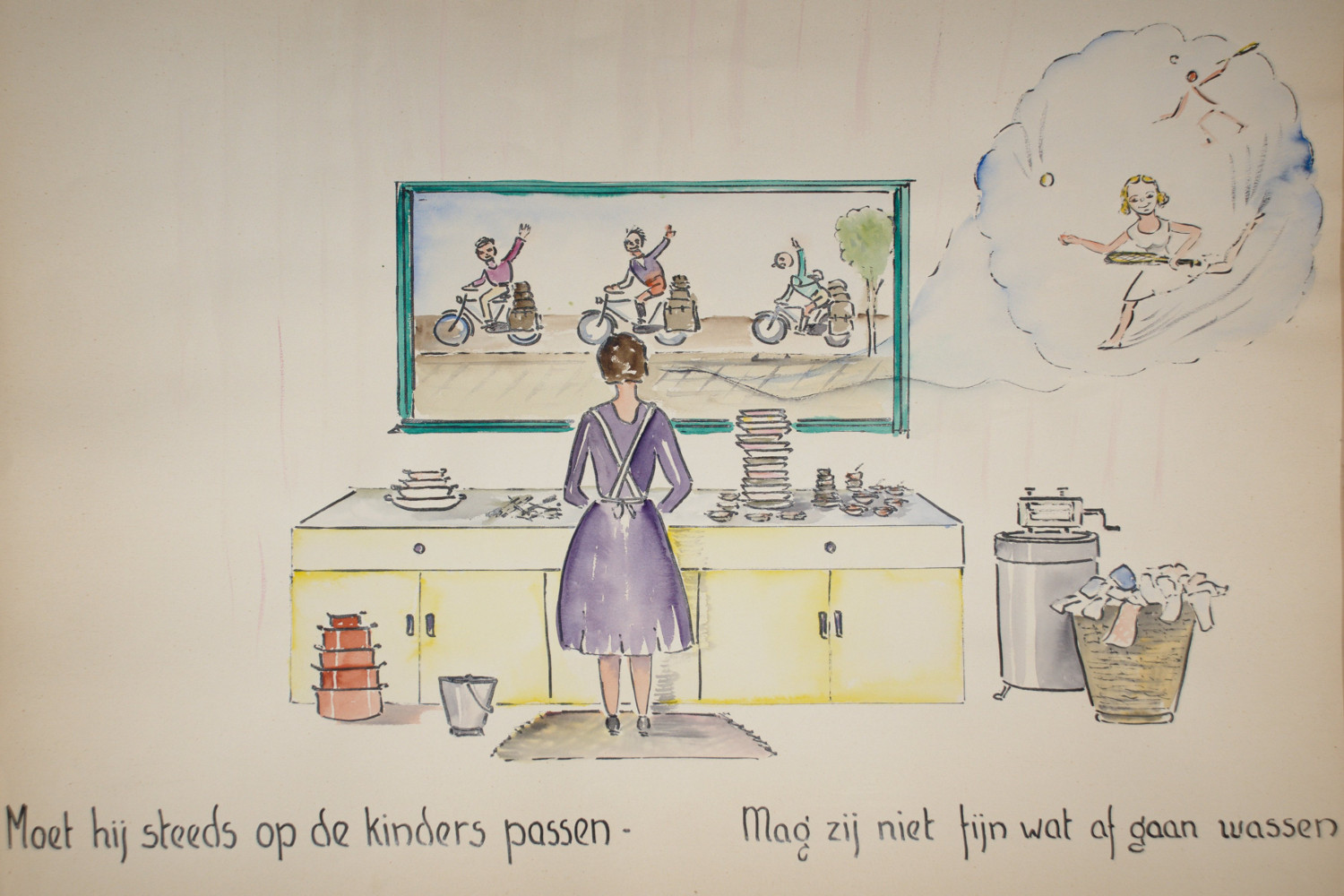
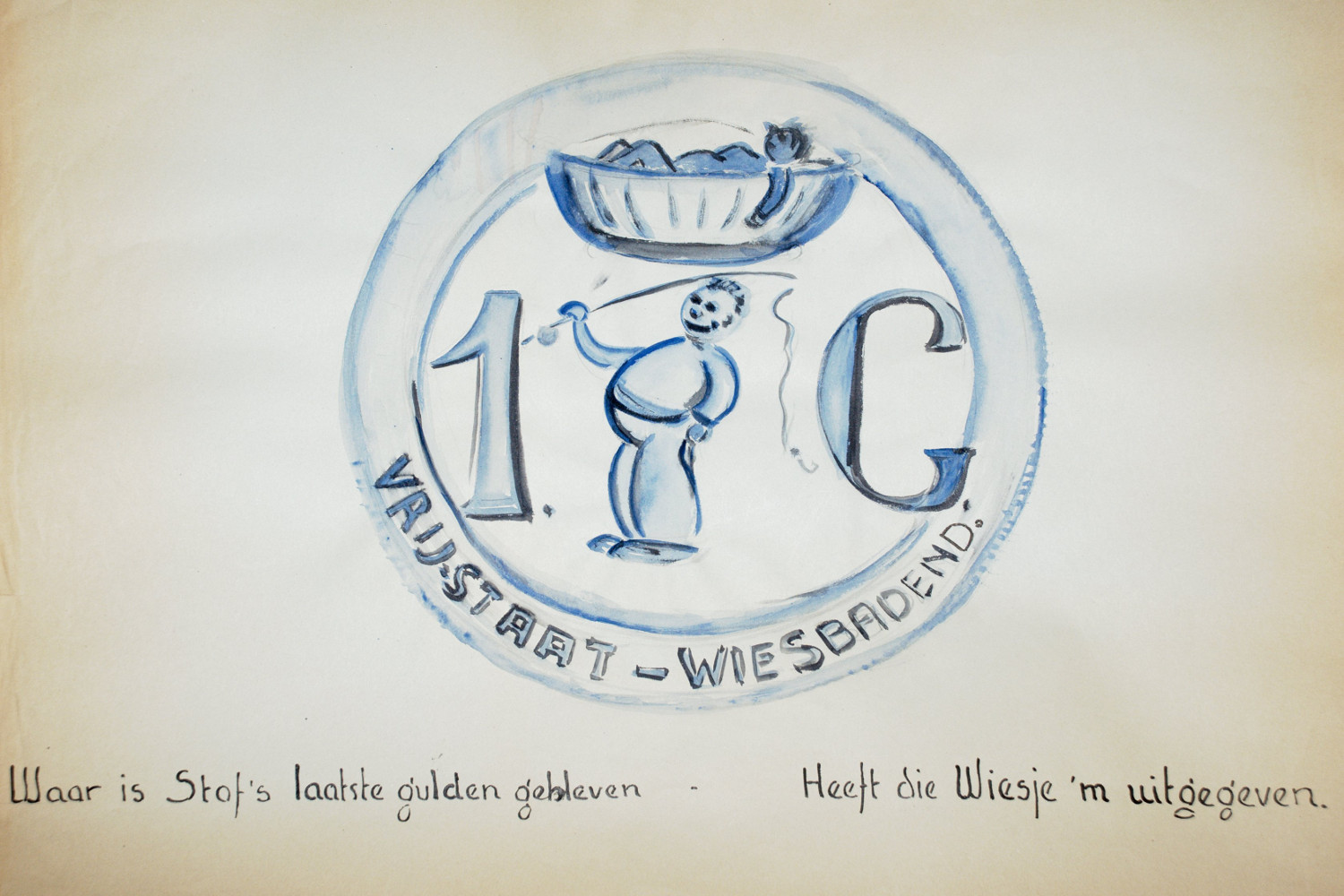
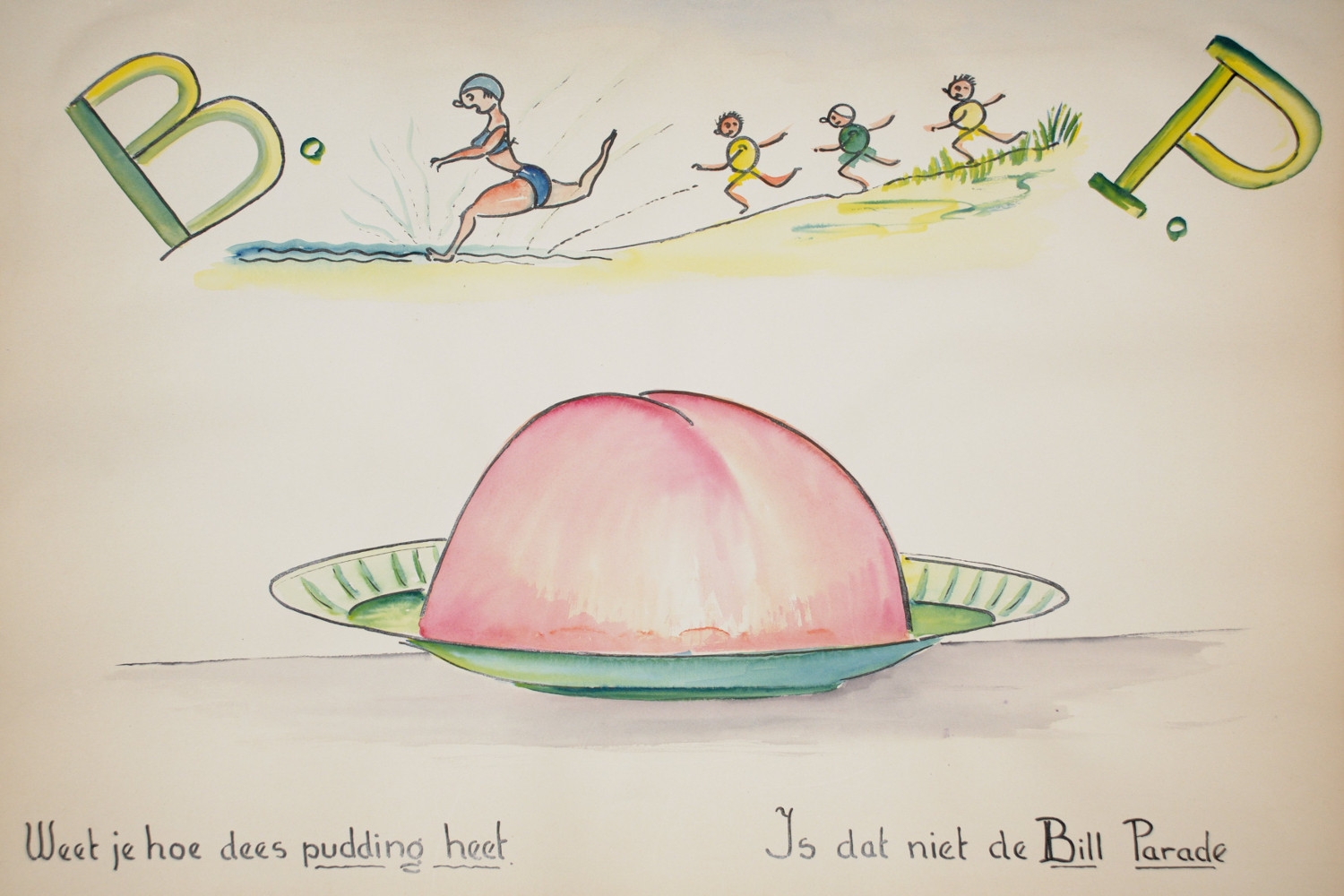
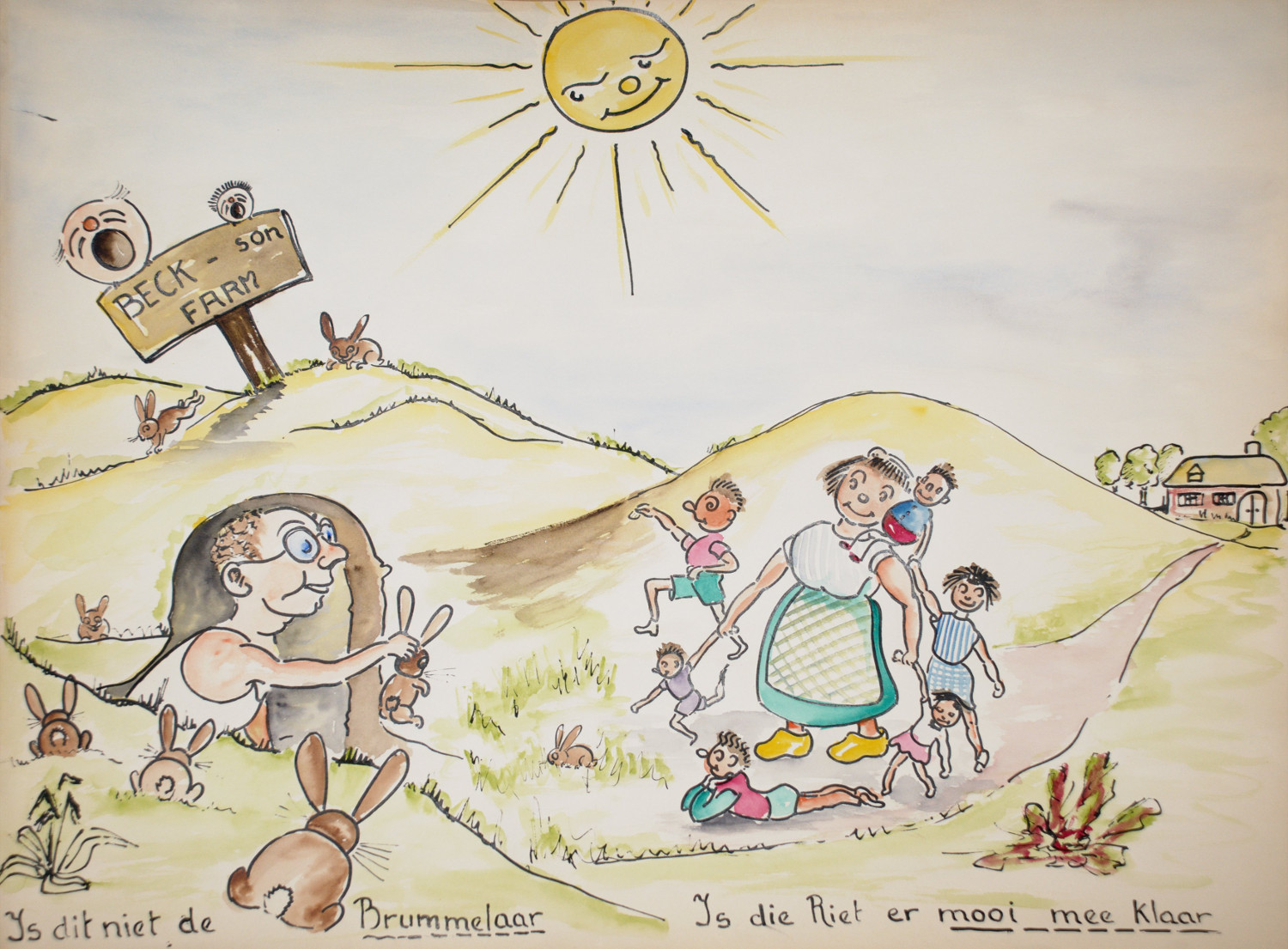
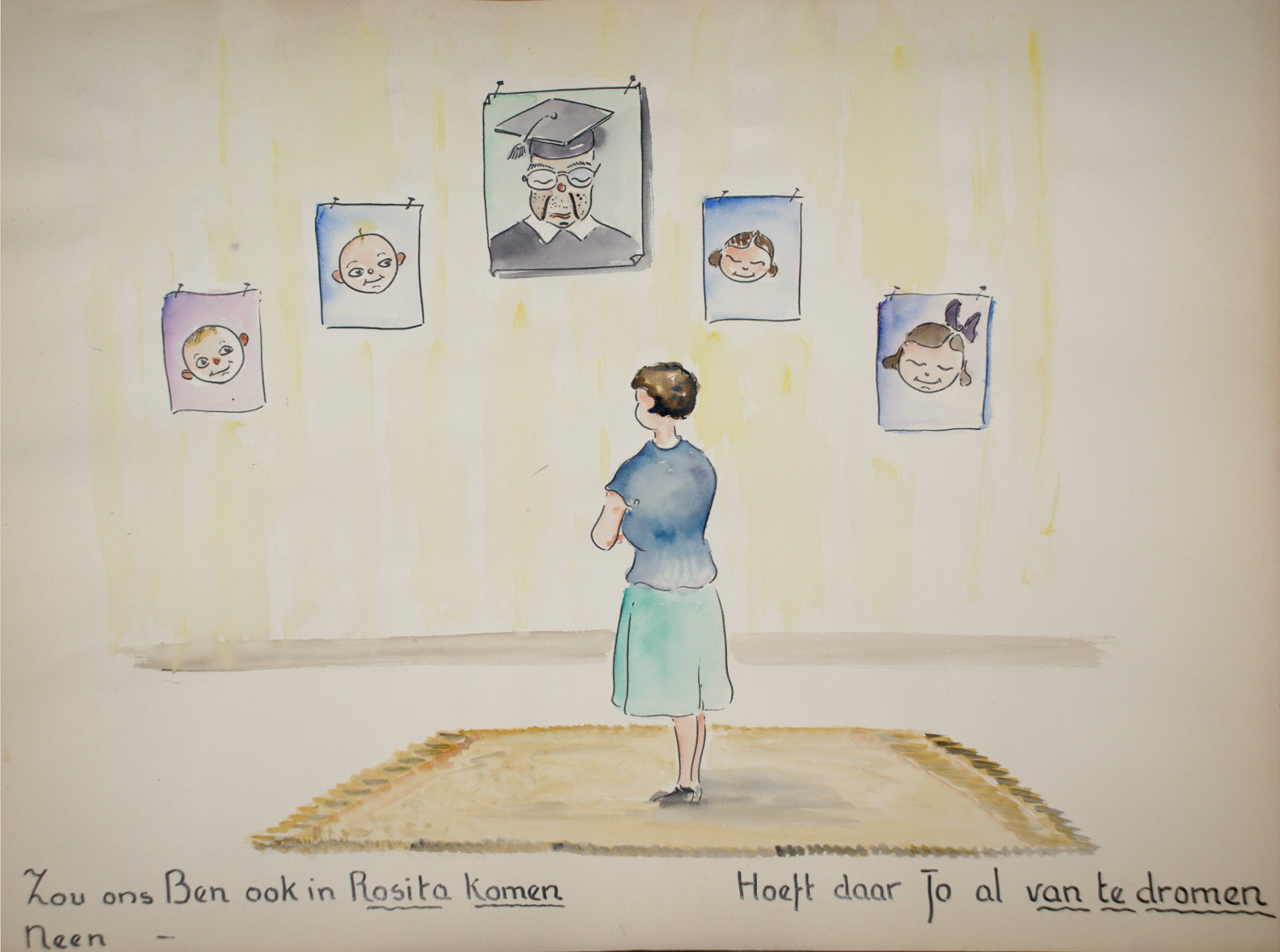
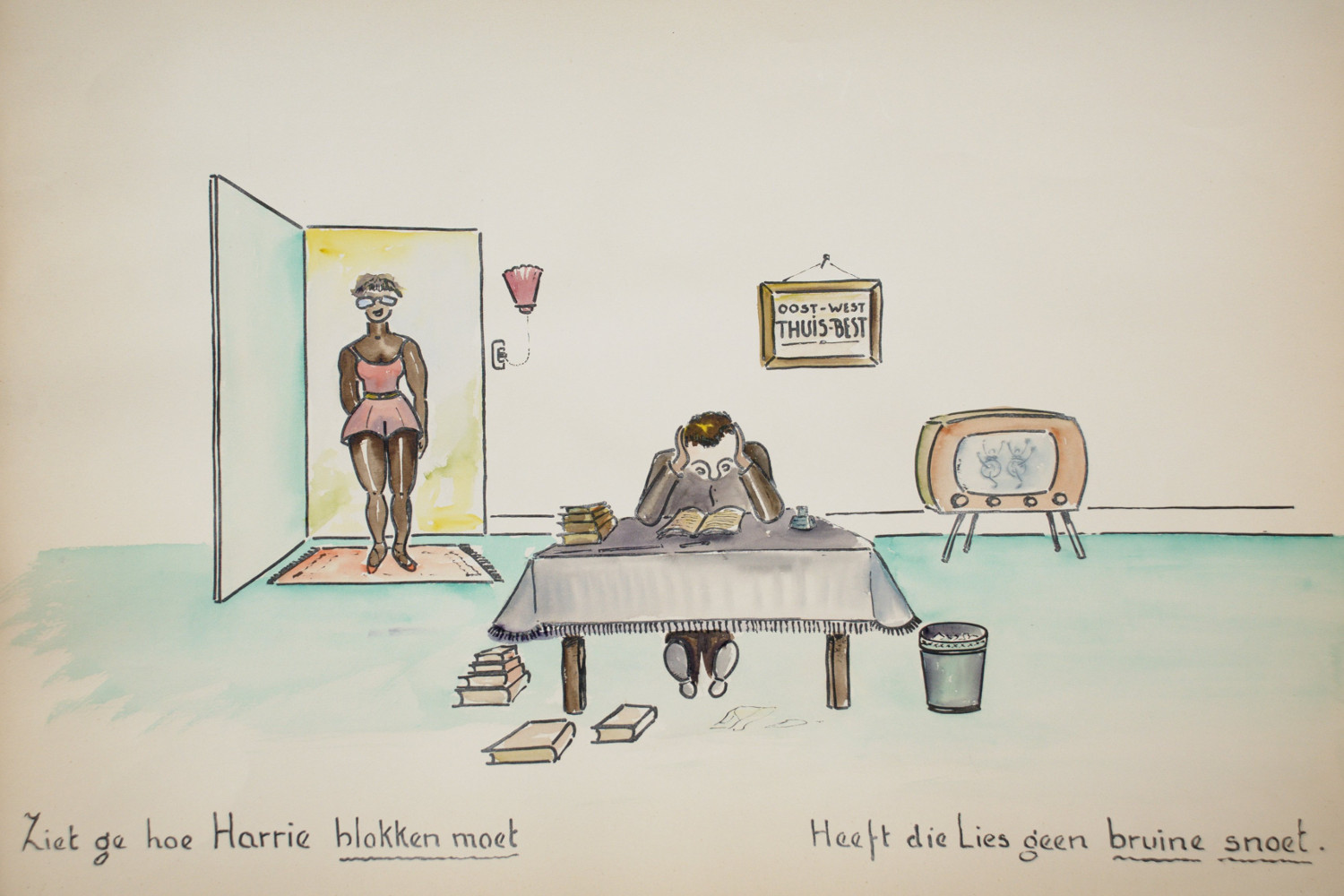
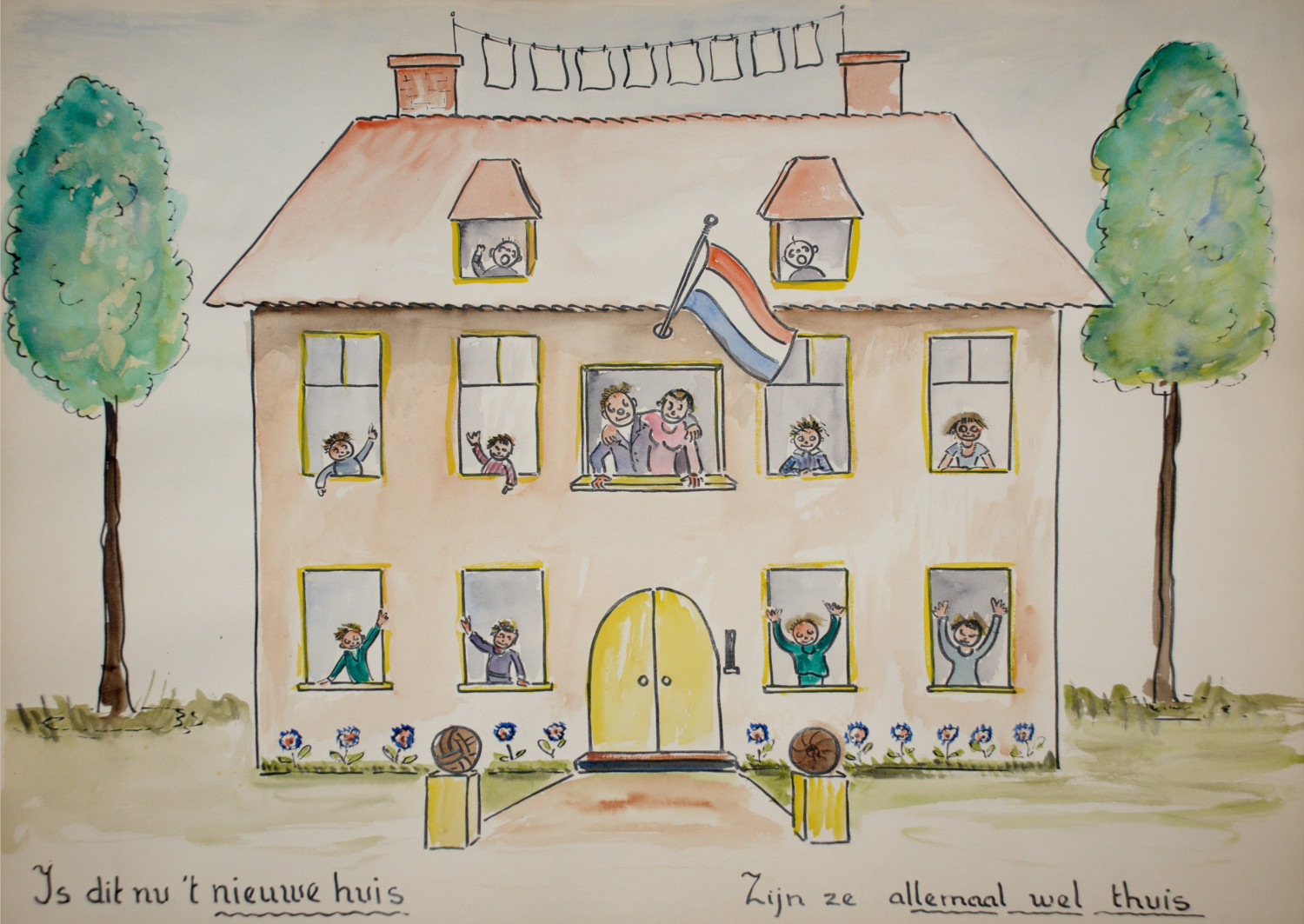
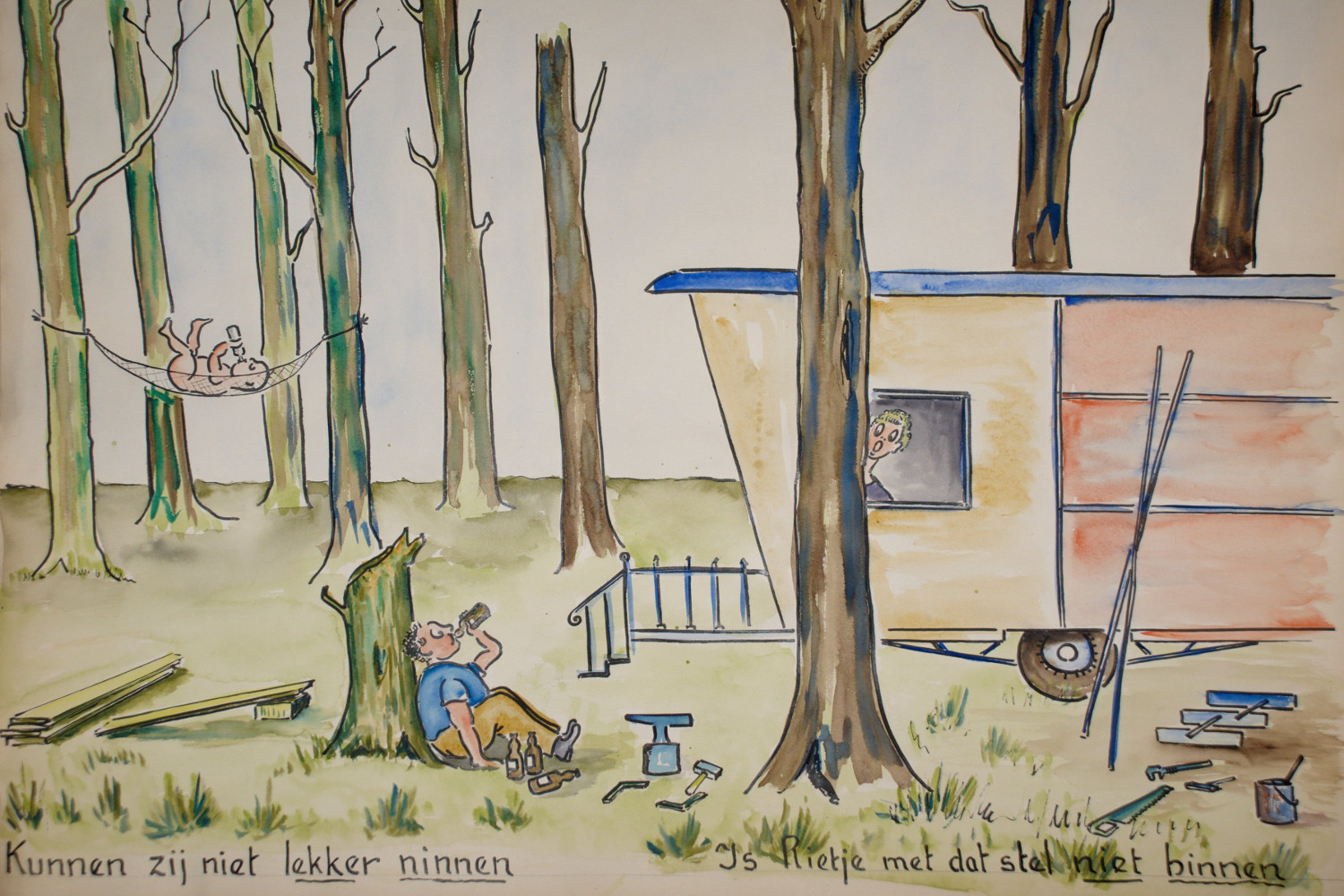
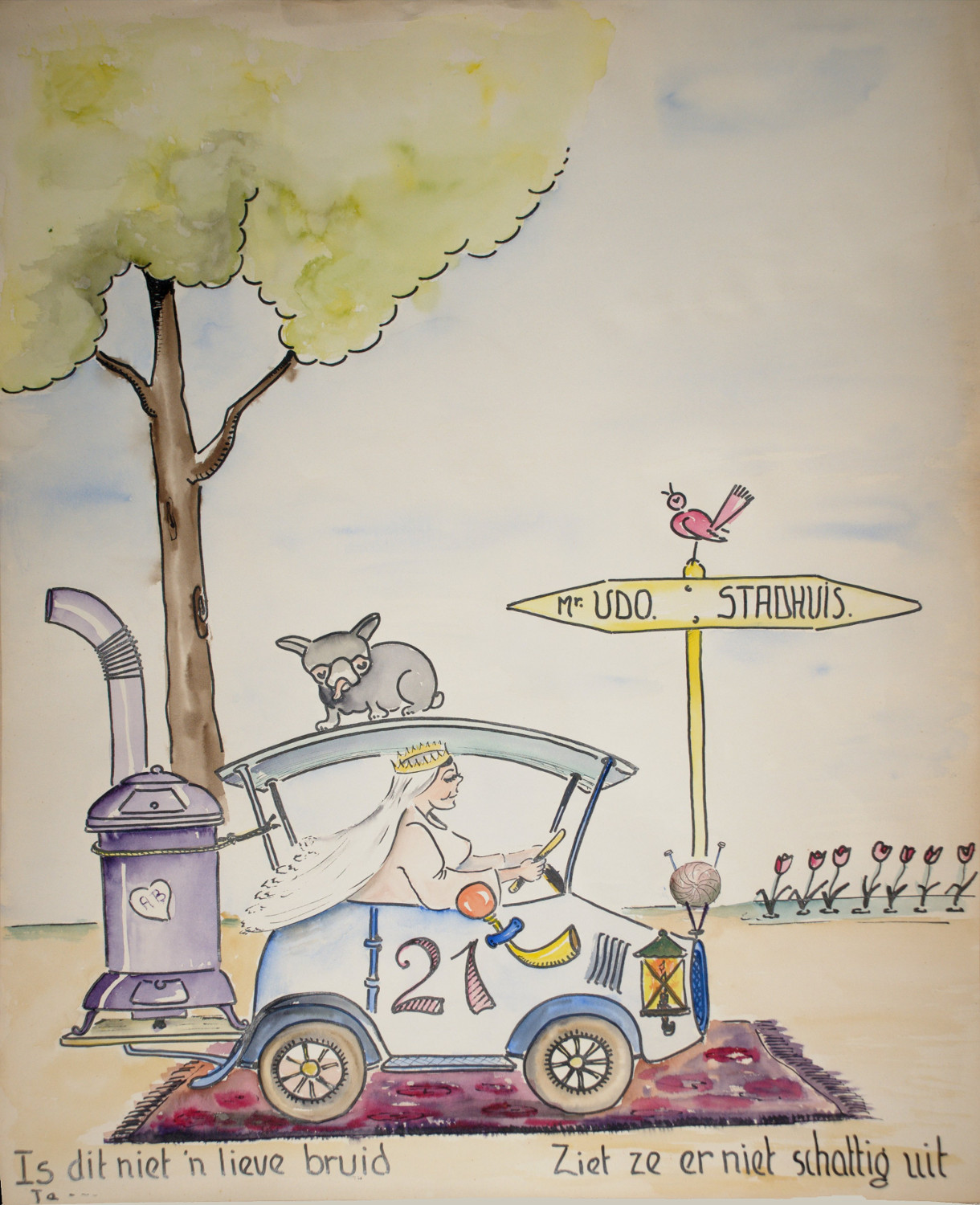

For family members there is a website jovideba.nl dedicated to Johannes Andreas van den Beemt and his descendants. If you are related, please send an email to steven@vandenbeemt.eu to get access.
—Eric Grivel
Sleeping at the Zoom was also quite special. I slept in bed with Pa and that lasted until almost everyone left home. The older boys slept in the small back room that was called “the Stuka” because of the bursts of fire fired under the covers.
—Frans van den Beemt
recorded in “Treesje van de Zoom”
by Elselien Withagen, 2005
Nici, Trees and I slept in one room. I had to sleep in a child’s bed until I was 12, when Nici got married and left the house and finally I got a big bed.
—Maria van den Beemt
recorded in “Treesje van de Zoom”
by Elselien Withagen, 2005
With Saint Nicholas we got warm mittens, shawls and hats, the gifts were useful things and not toys or anything. With birthdays we got ranja and likkoeken. That was real treat. On Sundays we ate meat, and minced meat once a week. The rest of the week we ate stew with a dimple of gravy. Then we licked our plate because porridge was coming.
—Maria van den Beemt
recorded in “Treesje van de Zoom”
by Elselien Withagen, 2005
If your shoes wore down, they were not taken to the cobbler because that was too expensive. No, Dad repaired the shoes himself. He kept all the broken ones in the attic in a large box and if someone needed a new pair, the box came out. The “new” pair was constructed from those old shoes and you could wear them again.
Of course we didn’t like that to walk around on old, patched up shoes, and one day Trees and I took revenge on that box of shoes. It happened that we were sitting together in the attic in the skylight, our legs dangling in the gutter. We often did that and knew of no danger. We were not really bored, but we did nothing. We just sat there, looking out at the Zoom. Often Netje was also there and we sometimes walked over the ridge of the roof. Great fun, but, as they say on television these days, “don’t try this at home.”
That day we were staring at the Zoom a bit. How far away it seemed from high up on the roof. But Trees didn’t think so at all and so we decided to see who was right. The box with shoes was used.
“The Zoom is really not that far,” Trees said. “Just look:” and the first broken shoe flew into the Zoom from our gutter. I could do that too, and there the second and third went, and all the broken shoes disappeared in the Zoom.
—Maria van den Beemt
recorded in “Treesje van de Zoom”
by Elselien Withagen, 2005
Father had a cigar factory in Dordrecht, but when, after the war of 1914–18, he could no longer get cheap workers there to make the cigars, he moved to Brabant. Brabant also had cigar makers and he had heard that De Werd’s cigar factory was for sale in the Kloosterstraat in Bergen op Zoom. The contents of the factory in Dordrecht were moved by ship to Bergen op Zoom via the Hollands Diep. The cargo was heavily insured because the Hollands Diep could be quite rough.
He started over in this new factory which he called Jovideba (derived from Jan van den Beemt, as Grandpa was called, but according to him Javadebe did not sound good). The production was such that money was made. That money was brought to notary Peree who would manage it. Father received a receipt from him that the money was invested. When things went wrong with the factory and father went to the notary for his money, it turned out that there was nothing left of it. The notary was arrested and imprisoned; dad went bankrupt.
Because he was a prominent Catholic, he approached the church. In those days it was very common to receive financial support from the church in an emergency, but Pastor Joren ignored him. Father had to go door to door with coffee and tea to earn a living.
—Harry van den Beemt
recorded in “Treesje van de Zoom”
by Elselien Withagen, 2005
When the Second World War arrived, Father became an “unemployed chief worker,” as they were called back then. Father subsequently joined the Tax Authorities as a letter writer because he had a neat handwriting and was an intelligent man. When notary Peree was released from prison, the good-natured Pa van den Beemt started to bridge with him again.
—Harry van den Beemt
recorded in “Treesje van de Zoom”
by Elselien Withagen, 2005
Dad said [Peree] had been punished enough and, moreover, his wife had also gone insane. When the factory was liquidated, the employees organized a Sinterklaas party for the Van den Beemt children. I still remember that I got a Negro doll.
—Maria van den Beemt
recorded in “Treesje van de Zoom”
by Elselien Withagen, 2005
When Pa went to bridge at Peree, he bicycled from the Zoom to the Wouwse weg. Our cat Moortje always walked along to the Difoga railroad crossing, there he waited for Pa to come back and then walked home again.
Playing bridge was a true obsession in our home. Everyone who came in, and especially the various suitors, was first asked if they could play bridge and if they could they were had to play right away. On Sunday, the bridge table was set up immediately after the high mass and then the game began. The participants sometimes changed, but, with a short break for dinner, they continued to play until late in the evening. At night, when I actually had to go to bed, I sometimes crawled under Dad’s chair and he was so absorbed in the game that he totally forgot about me and only reacted when I fell asleep under the chair and nodded against the chair legs. I have always maintained that I could not play bridge although I did participate in games in the military. Only when Dad turned 75 and a bridge drive with all the children and their spoouses was organized did Moosje learn how to bridge so that we could participate for the poodle prize.
—Frans van den Beemt
recorded in “Treesje van de Zoom”
by Elselien Withagen, 2005
[When I started out with the van den Beemt family] Nici was the boss in the house. We had to brush copper every week. Nici always pointed with her finger to what we had to do. We were not allowed to use Vim, only soap, because it did not sand and so you did not get any scratches. Yes, Nici knew exactly how to do it, but she didn’t do much herself.
The entire week had a fixed format: Monday washing day, Friday cleaning day, and Thursday meding day. Every Thursday afternoon I fixed holes in trousers, shirts and socks. I was always allowed to sit in Nici’s room. Nici was not bad. For example, in the winter when there was ice, I was allowed to go sledding with Trees and the little ones in the park. When we came home at the end of the afternoon, Trees quickly took care of the food and I cleaned up a bit. I always went home in the evening immediately after dinner. Trees took care of the dishes and such.
When Nici got married, Trees took over her household duties. At that time she was only fifteen years old. I had by now turned eighteen. One day Pa van den Beemt told me that I could earn more with the Rampart family. When I said goodbye, I cried, I was so sorry to leave. After two years I stopped there. I missed the cozy atmosphere of the Van den Beemt family. I belonged with them, while the Ramparts only saw me as a maid. I had to sit there completely separate to eat, while at Van den Beemt I would join them at the table. Fortunately my place on the Noordzijde Zoom was still open. Not for full days anymore, but I was also allowed to work at Stof and Nici.
—Netje de Vries
recorded in “Treesje van de Zoom”
by Elselien Withagen, 2005
= privacy | = photo | = memories | = contact information | = age information.